
Why Prep Work Is Most of a Paint Job in Eastover & Myers Park
Sep 28, 2026 · 5 min read
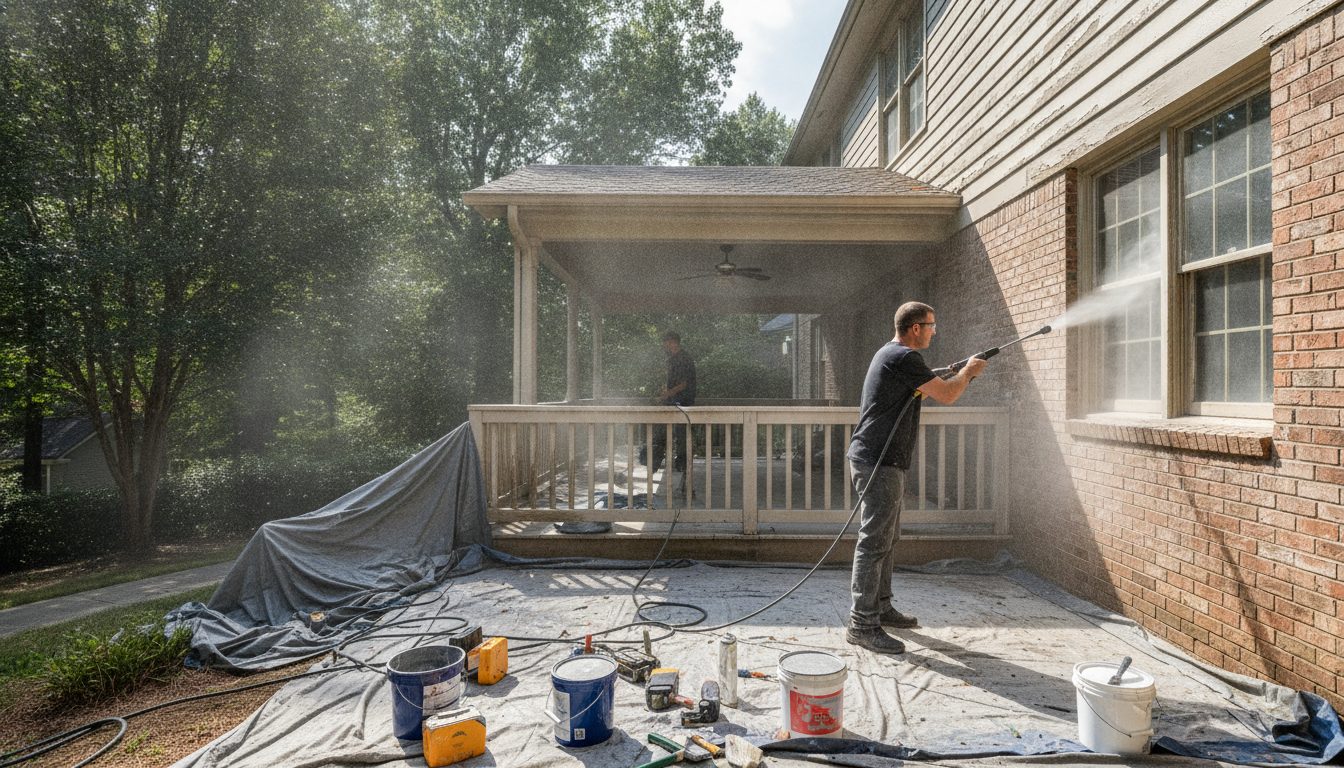
Ask anyone who has repainted a house in Eastover or Myers Park what took the longest, and it's rarely the rolling. It's the scraping, sanding, filling, and caulking that happens before a single coat goes on. Paint is the part people see. Prep is the part that decides whether that paint is still doing its job in a few years or peeling off by next summer.
We've been painting houses around Charlotte, Marvin, and Weddington since 2002. The finish coat is maybe a quarter of the actual labor on most jobs. The rest is getting the surface ready to hold it.
What Prep Actually Means
On an exterior, prep starts with pressure cleaning to strip off dirt, mildew, and the red clay staining that builds up on lower siding and trim in this area. Then comes scraping loose paint, sanding the edges smooth, and priming any bare wood before it sees another drop of moisture. Caulking gaps and cracks matters too — that's what keeps water from getting behind the paint film in the first place. Where the substrate calls for it, we'll recommend an elastomeric coating, which bridges hairline cracks better than standard paint. It's not the right call for every house, but on some older wood and stucco surfaces it makes sense.
Inside, prep looks like patching nail holes, filling gouges, sanding joints flat, caulking trim seams, and spot-priming repairs so they don't flash through the topcoat. On cabinetry, it means proper sanding and priming so the new finish actually bonds instead of chipping off in six months.
Why Older Charlotte Homes Need More of It
Eastover was laid out in 1927, and Myers Park isn't far behind it, both built along tree-lined streets with deep original trim and plaster walls instead of drywall. Repainting a 1920s house in Eastover almost always means dealing with decades of built-up coatings, wood windows that need careful prep rather than replacement, and plaster that has to be repaired to match the original profile — not skimmed over with drywall mud and called done. That's a different discipline than patching a modern wall, and it's why we handle drywall and plaster work in house rather than subcontracting it out.
Homes built before 1978 are also worth a straight conversation about lead-era paint. We don't sand or disturb old coatings without talking about that first. It's a live consideration on this housing stock, not an afterthought.
Trim matching original profiles in older homes is its own kind of prep. You can't just caulk and paint over a mismatched patch and expect it to look right — the profile has to line up before the finish goes on.
Mid-Century and Newer Homes Have Their Own Prep Needs
Foxcroft and Quail Hollow are mostly ranch and split-level homes on half-acre-plus lots, with long runs of original wood siding and trim. Exterior painting on these homes is less about historic plaster and more about surface area — long soffits and trim lines that need even sanding and consistent priming so the finish doesn't look patchy from one end of the house to the other.
Out in Marvin, homes sit on one to five wooded acres, and prep means covering a lot of ground — long soffits, deep porches, barns and outbuildings, and fencing, all under a heavy tree canopy that encourages mildew. Prep there often includes a thorough wash and mildew treatment before anything gets primed. In Weddington Chase and Providence Downs, the custom homes are newer, but prep still matters — new wood and trim need proper priming before the first coat, not just after.
Climate Plays a Role Too
Charlotte's hot, humid summers slow paint cure time and can trap moisture under a coat applied too fast. Spring brings heavy pine pollen that settles into wet paint if the timing is off. Spring and fall are the best windows for exterior work here; summer can work if we start early and stay ahead of the afternoon heat and storms. Good prep includes reading the weather, not just the wall.
What This Means for Your Estimate
When the owner walks your job, he's pricing the prep as much as the paint — how much scraping, how much plaster repair, how much caulking, how many coats of primer bare wood will need. That's why an itemized estimate is worth reading closely: it tells you where the work and the time are really going.
Frequently Asked Questions
Why does prep cost more time than the actual painting?
Because prep is what makes the paint stick and last. Scraping, sanding, filling, caulking and priming take far longer than rolling on a topcoat, especially on older homes with built-up layers of paint or original plaster.
Do you repair plaster or just cover it with drywall?
We repair it to match the original profile. A good share of our work is 1920s to 1940s plaster in Eastover and Myers Park, and it's a formal part of the business, done in house rather than subcontracted.
How does my home's age affect the estimate?
Older homes usually need more prep — old coatings, wood windows, plaster repair, and a conversation about pre-1978 lead-era paint before any sanding starts. The owner walks the job and accounts for all of it in your written, itemized estimate.
If you want a clear picture of what your house actually needs before it gets painted, call or text (704) 280-4264 for a free, itemized estimate. No obligation, and the owner writes it himself.
Want a number on your job?
The owner walks it with you and writes it up itemized. Free, no obligation.